
How to Style Quirky Plant Pots: 7 Creative Ideas

Table of Contents
- Why Quirky Plant Pots Deserve More Than a Windowsill
- Pick the Right Plant for Your Quirky Planter
- How to Arrange Plants on a Desk Without Clutter
- Cute Desk Accessories for Home Office Shelves and Corners
- Best Indoor Plants for Home Office Planters
- Grouping Quirky Plant Pots for Visual Impact
- Drainage and Stability Fixes for Unusual Containers
- Common Styling Mistakes to Avoid
- Frequently Asked Questions
Last Updated: September 16, 2026
Why Quirky Plant Pots Deserve More Than a Windowsill
A plant pot is furniture for your greenery, and most people treat it like an afterthought. Learning how to style quirky plant pots turns a novelty planter from a lone object into part of a room's personality, and it costs nothing beyond a bit of rearranging.
This guide shows you how to choose the right plant, arrange it on a desk, group pots for impact, and fix the two problems that trip up almost everyone: drainage and stability.
Quirky plant pots are decorative containers shaped as characters, faces, animals or abstract forms, designed to hold a living plant rather than sit empty as an ornament. A pot that never gets planted is a dust collector; a pot with the right plant in it becomes a focal point.
Pick the Right Plant for Your Quirky Planter
Match the plant to the pot's shape before you match it to your taste. Trailing plants suit hanging and tall designs, compact rosettes suit bowls, and upright growers need depth. Most styling failures start here: a heavy monstera in a small character pot looks top-heavy, while a tiny succulent lost in a wide bowl reads as an accident rather than a choice.
Matching Plant Size to Pot Size
Aim for a plant roughly one and a half to two times the height of the pot. That ratio keeps the character visible while letting the foliage frame it.
- Trailing plants (string of pearls, ivy, trailing pothos) suit the Face Hanging Planter, where the abstract face sits above cascading growth
- Small cacti and succulents suit bowls like Hettie the Hedgehog Planter Bowl, where the low profile keeps the shape readable
- Compact flowering plants suit character planters with dangling legs, where the pot is the star and the plant is the hair
How to Arrange Plants on a Desk Without Clutter
The rule for a desk is odd numbers and one clear zone. Three pots of different heights, grouped to one side, look intentional; six spread evenly look like a shop display. Clear everything off, add your largest pot off-centre, then build outward with two smaller pots, varying height by 5cm to 10cm. Leave the front third empty so the eye has somewhere to rest.

Keep the tallest plant at the back so it never blocks your sightline to the screen. If you use a monitor riser, the shelf underneath is prime real estate for a low bowl planter.
Cute Desk Accessories for Home Office Shelves and Corners
Cute desk accessories for home office spaces work best when they share a colour family with your planters. A shelf with three unrelated colours reads as clutter; three tones of one colour reads as a collection. Pick a base colour from your room, then choose accessories one or two shades either side of it. A matte pink hanging planter pairs naturally with a warm wooden shelf and a soft grey notebook. Add one small contrasting item only.
Plant Mum Planter with Dangling Legs & →
For corners, go taller. A hanging planter at eye level draws the eye up and makes a cramped corner feel deliberate rather than forgotten. The Face Hanging Planter is a good candidate here because its abstract face gives the corner a subject.
Best Indoor Plants for Home Office Planters
The best indoor plants for home office use tolerate inconsistent watering and moderate light. Most home offices have no direct sun and a radiator nearby, which rules out anything fussy. Good options include pothos, snake plants, spider plants, ZZ plants and most small cacti, all cope with a desk a metre or two from a window and forgive a missed week of watering.
| Plant | Light Needs | Watering | Best Pot Style |
|---|---|---|---|
| Pothos | Low to bright indirect | Weekly | Hanging planter |
| Snake plant | Low | Every 2-3 weeks | Tall character pot |
| Spider plant | Bright indirect | Weekly | Bowl planter |
| Small cactus | Bright | Every 3-4 weeks | Shallow bowl |
| ZZ plant | Low | Every 2-3 weeks | Any upright pot |
If you struggle to judge moisture, a terracotta sensor takes the guesswork out. Willy the Garden Worm sits in the soil and changes colour as it dries, going dark when watered and pale when the plant is thirsty.

Grouping Quirky Plant Pots for Visual Impact
Grouping is where quirky plant pots stop being individual novelties and start being decor. Three to five pots at staggered heights create a single composition with far more visual impact than the same pots scattered around a room.
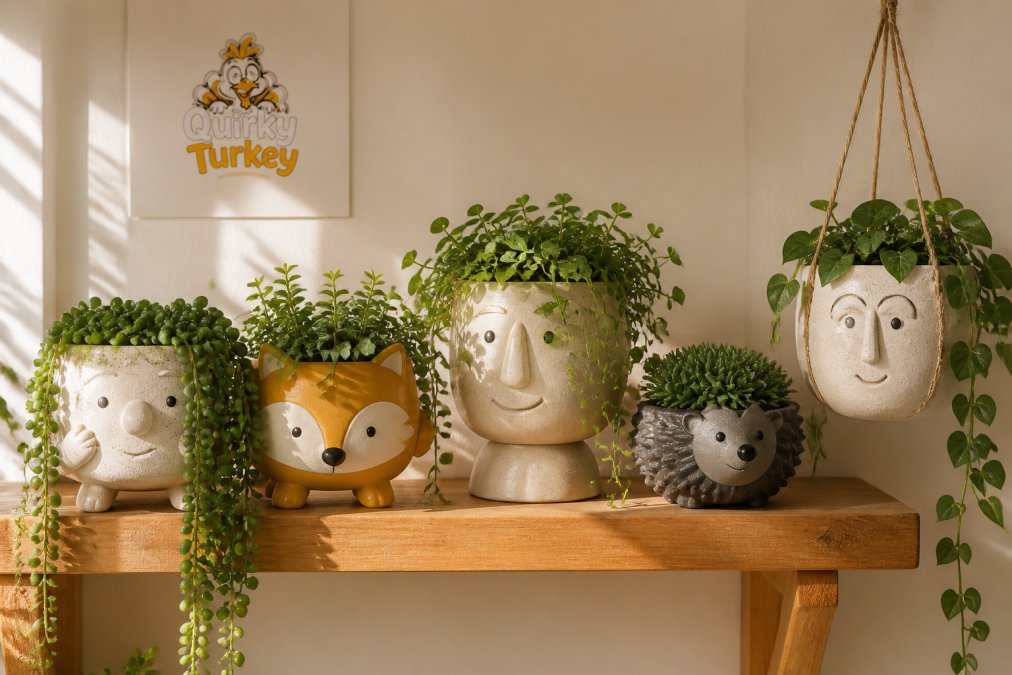
Build the group around one anchor pot, usually the largest or most detailed, placed slightly off-centre. Add supporting pots at different heights, and let at least one trail downward to break the shelf's horizontal line.
Colour Coordination and Contrast
Choose one approach and commit: coordinate within a narrow palette, or contrast one bold colour against neutrals. Mixing both is what makes a shelf look messy.
- Coordinated: matte black, matte pink and natural terracotta together
- Contrasted: one vibrant character pot against plain white or grey ceramics
- Textured: mix smooth ceramic, matte finishes and raw terracotta for depth without colour clash
Drainage and Stability Fixes for Unusual Containers
Most quirky planters are decorative first, functional second, no drainage hole, a narrow base, or a shape that tips. Both problems have simple fixes, but the details matter.
No drainage hole: plant into a slightly smaller plastic nursery pot and drop that inside the decorative one. Water the inner pot, let it drain fully in the sink, then return it. This keeps the character pot dry and the plant healthy.
How to Drill Drainage Holes in Quirky Materials
A 6mm to 10mm masonry bit is the starting point for ceramic and terracotta.
Plant Mum Planter with Dangling Legs & →
Narrow or rounded base: add a layer of washed gravel or small stones to the bottom for weight, then sit the inner pot on top. For top-heavy designs, a small adhesive rubber foot under the base stops sliding on smooth surfaces.
Stability for Top-Heavy and Hanging Designs
Common Styling Mistakes to Avoid
The most common mistake is treating every quirky pot as a solo display.
Plant-to-Pot Proportion: The Rule of Thirds
A plant should occupy roughly two-thirds of the total height of the pot-and-plant combination.
Seasonal Styling Transitions
Other frequent errors:
- Same height everywhere. Flat rows of pots read as storage, not styling
- Too many characters together. Two or three novelty shapes maximum per group, then balance with plain pots
- Ignoring scale. A tiny pot on a huge surface shrinks into the background
- Forgetting the plant's growth. A trailing plant that outgrows its shelf will drag the pot off the edge
- Buying for the pot, not the plant. Always know what's going in it before you commit
- Skipping the seasonal swap. A display that never changes stops being noticed
Frequently Asked Questions
How do I stop a quirky planter from leaking water onto my desk?
Most character planters are decorative rather than watertight. Keep the plant in its original nursery pot and lift it out to water, letting it drain fully before returning it. If the pot has no hole, add a 2cm layer of gravel at the base and use a moisture sensor like a terracotta worm to check when the soil actually needs water, so you never overwater in a sealed container.
What plants work best in unusual or quirky containers?
Small, slow-growing plants cope best with the limited root room. Succulents, cacti, spider plants and pothos all work well in character planters and hedgehog bowls. For hanging face planters, trailing plants such as string of pearls or ivy look best because the foliage spills over the edge. Larger plants like monstera need a pot at least 5cm wider than the root ball, so save those for standard planters.
Can I mix quirky plant pots with my existing home decor?
Yes, and a single characterful pot usually works better than five. Treat it as a focal point: place one quirky planter on a shelf or desk and keep the surrounding pots plain terracotta or matte ceramic. Repeat one colour from the room, such as a blue planter matching a cushion, so the piece feels intentional rather than random. Grouping three pots of different heights creates visual impact without overwhelming a small space.
How do I style quirky plant pots in a small home office?
Work vertically. A hanging planter frees up desk space, while a shelf at eye level puts character pieces where you actually see them during the day. Arrange plants on a desk in odd numbers and vary the heights, using a small bowl planter at the front and a taller pot behind. Keep the potting mix topped up and rotate plants weekly so they get even light on all sides.


