
How to Return Damaged Gift Items: A Step-by-Step Guide

Table of Contents
- Understanding Your Consumer Rights for Damaged Gifts
- How to Document Damaged Deliveries Properly
- Time Limits for Returning Faulty Items
- Returning Gifts Without a Receipt: What You Need to Know
- How to Write a Return Request Email That Gets Results
- Refund vs Exchange: Which Option Suits Your Situation
- The Social Side of Returning a Damaged Gift
- Conclusion
Understanding Your Consumer Rights for Damaged Gifts
How to return damaged gift items is one of the most common frustrations gift-givers and recipients face. When a present arrives damaged, it's not just about getting your money back, it's about understanding what the law actually guarantees you. In the UK, you have statutory rights that protect you far more robustly than most retailers' standard policies.
The Consumer Rights Act 2015 establishes that goods must be of satisfactory quality and fit for purpose. When you receive a damaged gift, this protection applies regardless of whether you purchased it yourself or received it as a present. The key distinction is that you have rights as the person who received the item, even if someone else paid for it.
What makes returning damaged gifts tricky is the grey area around "proof of purchase." Unlike returns you initiate yourself, gift returns often lack a receipt. This doesn't eliminate your rights, it just changes how you document them. Understanding this distinction early saves frustration later.
How to Document Damaged Deliveries Properly
The moment a package arrives, your documentation begins. Before opening anything, photograph the exterior packaging from multiple angles. Capture any visible damage to the box, dents, tears, or signs of rough handling. These images establish the condition upon arrival and protect you if the retailer questions whether damage occurred in transit.
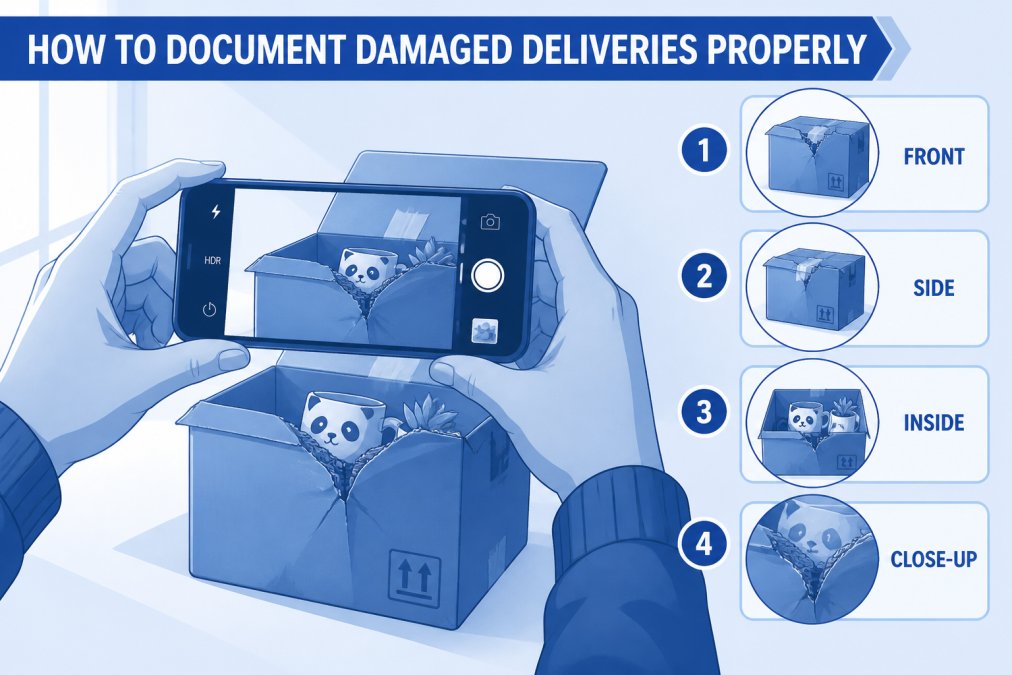
Open the package carefully and inspect the item itself. If it's broken, cracked, or defective, photograph it immediately from multiple angles. Include photos showing how the damage appears, a hairline crack, a broken component, discolouration. The more specific your documentation, the stronger your position when you contact the retailer.
Write down the date you received the package and the date you discovered the damage. If the damage wasn't immediately visible, note this too. Some items reveal defects only after careful inspection, and retailers need to understand your timeline. This detail matters because it demonstrates you weren't negligent in handling the item.
Keep all original packaging, tissue paper, and protective materials. Retailers often request that you return items in original condition with all packaging intact. Even if the packaging is damaged, keeping it shows you've preserved everything as received. This compliance makes your return request far more likely to succeed.
Time Limits for Returning Faulty Items
The Consumer Rights Act 2015 gives you 30 days from receipt to return faulty goods. However, this is a minimum standard, not a maximum. Many retailers offer longer return windows, and understanding both timelines protects you.
Within the first 30 days, you have the strongest legal position. The retailer must assume the fault existed when the item was delivered unless they can prove otherwise. After 30 days, the burden shifts, you'd need to prove the item was faulty at the point of sale, which becomes significantly harder with damaged gifts that may have been handled by multiple people.
If you're returning a damaged gift, act within two weeks if possible. This timeframe demonstrates urgency and shows you've inspected the item promptly. Retailers view quick returns more favourably because they can resell the item or process a refund efficiently. Waiting six weeks signals either negligence or that you've used the item, both of which weaken your position.
For items ordered during the festive season, many retailers extend return windows to mid-January. Check the retailer's specific policy before assuming the standard 30-day window applies. Some luxury retailers or specialist gift companies offer 60-day returns, particularly for items that might be gifted.
Returning Gifts Without a Receipt: What You Need to Know
This is where many gift recipients panic unnecessarily. A missing receipt doesn't invalidate your return. The person who received the gift, you, has rights under consumer law regardless of who purchased it or whether you have proof of purchase.
What you do need is proof of transaction. If the item was purchased online, ask the gift-giver for their order confirmation email. This document shows the retailer, the product, the purchase date, and often includes an order number. For in-store purchases, this becomes trickier, but most retailers can look up transactions using a credit or debit card number.
If you absolutely cannot locate a receipt or order confirmation, contact the retailer directly with the following information: the item description, the approximate purchase date, and your contact details. Many retailers maintain transaction records and can locate the purchase using these details. Provide photos of the damaged item and packaging, this often expedites the process because the retailer can see the problem immediately.
Some retailers require a gift receipt specifically, which is simply a receipt without pricing information. If the gift-giver didn't request one, ask whether they kept the original receipt. Even if they're reluctant to share it, explain that you need it only to verify the purchase, you're not asking for personal financial information.
For items purchased from online marketplaces like Amazon or eBay, the situation differs slightly. You have rights as the recipient, but the original purchaser may need to initiate the return. Contact the marketplace's customer support and explain you're the gift recipient with a damaged item. Most platforms now allow the recipient to manage returns directly if they have the order number.
How to Write a Return Request Email That Gets Results
Your return email is your first formal communication with the retailer. It sets the tone for the entire return process and significantly influences whether you'll receive a swift resolution or face unnecessary delays.
Start with a clear subject line: "Return Request for Damaged Item - Order [Number]" or "Damaged Gift Return - [Item Name]." This immediately tells the retailer what you need without forcing them to read the entire email to understand your purpose.
In the opening paragraph, state the problem directly: "I received [item name] on [date], and it arrived damaged. I'm requesting a return and refund." This clarity prevents misunderstandings. Follow with a brief explanation of the damage, don't over-explain, but be specific enough that the retailer understands the severity.

Include the following information in your email:
- Order number (if you have it)
- Item name and description
- Date received
- Brief description of damage
- Attached photos (or note that you'll send them separately if the email is too large)
- Your preferred resolution (refund or exchange)
- Your contact details and availability
Keep the tone professional but friendly. Avoid anger or accusation, retailers respond better to calm, factual communication. You're not blaming them personally; you're describing a situation that needs resolution.
If you don't have an order number, include as much detail as possible: the approximate purchase date, the price range if you know it, and where you believe it was purchased. This helps the retailer locate the transaction in their system.
Request a response timeframe: "Please confirm receipt of this email and let me know the next steps within 48 hours." This sets expectations and shows you're taking the matter seriously. Most retailers respond to well-documented return requests within 2-3 business days.
Close with a simple thank you: "Thank you for your attention to this matter. I look forward to resolving this quickly." This maintains goodwill and keeps the door open for positive communication.
Refund vs Exchange: Which Option Suits Your Situation
When you're returning a damaged gift, you have two primary options: a refund or an exchange. Understanding which suits your situation prevents unnecessary back-and-forth with the retailer.
A refund returns your money (or the gift-giver's money if they're processing the return). This is straightforward when the item is clearly faulty or damaged beyond repair. Choose a refund if you've lost confidence in the product quality or if the retailer doesn't stock the item anymore. Refunds typically take 5-10 business days after the retailer receives and inspects the returned item.
An exchange sends you a replacement item. This is faster than a refund-and-rebuy scenario and often preferred by retailers because they can inspect the original item and resell it if it's only slightly damaged. Choose an exchange if you love the item but received a defective unit. Exchanges often arrive within 3-5 business days because the retailer prioritises getting you a working replacement quickly.
Some retailers offer store credit as a middle ground, you receive the value as credit toward future purchases rather than cash back. This option benefits the retailer because it keeps money within their system, but it also benefits you if you're likely to shop with them again. Store credit often processes immediately, giving you instant purchasing power.
For damaged gifts, consider the gift-giver's perspective. If they chose that specific item carefully, an exchange might feel more aligned with their original intent. If the item simply isn't right for you, a refund gives everyone flexibility to choose something different.
The Social Side of Returning a Damaged Gift
Returning a damaged gift involves an awkward social dynamic that many guides overlook. The gift-giver invested time and money in choosing something special, and returning it, even when it's damaged, can feel like rejection.
Start by communicating with the gift-giver before you initiate the return. A simple message, "The plant pot arrived with a crack in the base. I love the design, but it won't hold water. I'm going to contact the retailer about an exchange", frames this as a logistics issue, not a rejection of their gift. Most gift-givers appreciate this transparency and feel relieved that you're handling it rather than pretending to like a broken item.
If the gift-giver purchased from a retailer like Quirky Turkey Gifts, they may have received a receipt or order confirmation. Ask them if they'd be willing to share this information. Frame it as helpful rather than obligatory, "Do you happen to have the order number? It'll speed up the return process." Most people are happy to help when they understand why.
When the replacement arrives, close the loop by thanking the gift-giver again. "The new pot arrived, and it's perfect. Thank you again for thinking of me." This reinforces that you valued their choice; the original item simply had a manufacturing fault.
If you're requesting a refund rather than an exchange, be especially communicative. Explain that you're returning the damaged item and perhaps suggest an alternative: "I'm returning it for a refund. I've been eyeing [different item] instead, would you mind if I grabbed that with the refund credit?" This keeps the spirit of gift-giving alive even though the original item didn't work out.
For gifts from people you're less close to, keep communication brief and factual. A simple "Thank you so much for the gift. It arrived damaged, so I'm arranging a return with the retailer" suffices. You're not obligated to provide extensive explanation or updates on the return process.
The most important principle: never make the gift-giver feel guilty. They chose something thoughtful; a manufacturing fault or delivery damage isn't their responsibility. By handling the return smoothly and keeping them informed, you preserve the relationship and the spirit of their generosity.
Returning a damaged gift doesn't have to derail your gratitude or strain your relationship with the gift-giver. By documenting the damage properly, understanding your consumer rights, and communicating clearly with both the retailer and the person who gave you the gift, you can resolve the situation quickly and fairly. Start by gathering your photos and order details, then reach out to the retailer's support team with confidence. You have more protection than you might think.
Frequently Asked Questions
What are my consumer rights for faulty goods under the Consumer Rights Act 2015?
The Consumer Rights Act 2015 gives you the right to reject faulty or damaged goods within 30 days of purchase and receive a full refund. After 30 days, you can still claim a repair or replacement within six months, though the retailer may deduct wear and tear. For gifts, these rights apply to the person who received the item. Damage caused during delivery is the retailer's responsibility, not yours, so you're entitled to a full refund or replacement without question.
Do I have to pay to return damaged goods?
No. If the item arrived damaged or is faulty, the retailer must cover return costs. Most offer a free collection service or provide a prepaid return label. You should never be charged for returning a defective item. If a retailer asks you to pay for the return, contact them again and reference your statutory rights under the Consumer Rights Act 2015. If they refuse, escalate to the Citizens Advice Consumer Service.
Can I return an item that was a gift if I don't have the receipt?
Yes, you can return a damaged gift without a receipt. The person who received the gift has consumer rights regardless of whether they purchased it. You'll need proof of purchase (the gift receipt if available, or the original packaging with delivery details) and documentation of the damage. Contact the retailer's customer support with photos of the damage and explain it was a gift. Most retailers will process the return based on the delivery address and order details.
How do I prove an item arrived damaged?
Document the damage immediately upon delivery: photograph the package exterior, the opened packaging, and the damaged item from multiple angles. Capture any dents, cracks, stains, or broken components clearly. Keep the original packaging and any protective materials intact. If the item is unusable, note this in writing. Send these photos with your return request email. This documentation is crucial for your claim and helps the retailer process your return quickly without dispute.
This article was written using GrandRanker