
How to Care for Ceramic Plant Pots in Winter

Table of Contents
- Why Ceramic Plant Pots Crack in Winter
- Understanding Freeze-Thaw Cycles and Thermal Shock
- How to Clean Ceramic Pots Before Storage
- Using Pot Feet for Drainage and Ground Protection
- Preventing Frost Damage to Garden Pots
- Glazed vs. Unglazed Ceramic: Which Survives Winter Better
- Step-by-Step Winter Care for Ceramic Plant Pots
- Conclusion
Last Updated: August 24, 2026
Why Ceramic Plant Pots Crack in Winter
Ceramic plant pots are beautiful but vulnerable when temperatures drop. 🌡️ The culprit isn't just cold, it's what happens when water trapped inside the ceramic freezes and expands. Ceramic is porous and absorbs moisture through its walls and base. When temperatures plummet below freezing, that water expands as it turns to ice ([EXTERNAL_LINK: USGS Water Science School | usgs.gov]). The rigid ceramic can't stretch to accommodate the expansion, so hairline cracks form, often spreading from the base upwards. Over repeated freeze-thaw cycles, these fractures compromise the pot's structural integrity entirely.
Understanding winter care for ceramic plant pots is essential if you want your collection to survive the season. The good news: most damage is preventable with the right approach.
Understanding Freeze-Thaw Cycles and Thermal Shock
A freeze-thaw cycle occurs when temperatures oscillate around the freezing point, typically in autumn and spring. Each cycle is brutal on ceramic because the material expands and contracts repeatedly.
Thermal shock, sudden temperature changes, accelerates this damage. A pot warming to 10°C in winter sun, then plummeting to −5°C at night, stresses the ceramic at a molecular level. The outer layers contract faster than inner layers, creating internal tension that leads to cracking.
Why Material Composition Matters More Than You Think
Not all ceramics behave the same way in freeze-thaw cycles. Firing temperature and clay composition fundamentally change how a pot responds to winter.
Low-fire terracotta (fired at 1000-1150°C) is highly porous, absorbing 8-12% of its weight in water. When that water freezes, it expands roughly 9% in volume, creating outward pressure throughout the entire pot. Low-fire terracotta has lower compressive strength and shatters after just two or three hard freeze-thaw cycles.
High-fire stoneware (fired at 1200-1300°C) is denser and less porous, absorbing only 1-3% of its weight in water. The clay particles fuse more completely during firing, creating a tighter matrix that resists internal pressure more effectively. High-fire stoneware can often survive multiple freeze-thaw cycles outdoors with basic protection, whereas low-fire terracotta almost always requires wrapping or indoor storage.
Glazed ceramic adds a sealed surface layer that prevents water absorption through pot walls, but the glaze itself can fail if the underlying clay expands unevenly. A thick, well-bonded glaze on higher-quality ceramics performs better than thin glazes on low-fire bodies.
Regional Freeze-Thaw Intensity Varies Dramatically
The number of freeze-thaw cycles your pots experience depends on your local climate. Areas with stable, consistently cold winters are actually less damaging than regions with frequent temperature swings around freezing.
In regions where winter temperatures fluctuate between −2°C and +5°C repeatedly, pots experience 10-20 freeze-thaw cycles per winter ([EXTERNAL_LINK: NOAA US Climate Normals | ncei.noaa.gov]). In contrast, regions with stable sub-zero temperatures may see only 2-4 significant cycles. If your area experiences frequent thawing and refreezing, low-fire terracotta pots left outdoors are at severe risk. High-fire stoneware and glazed ceramics fare better but still benefit from protection.
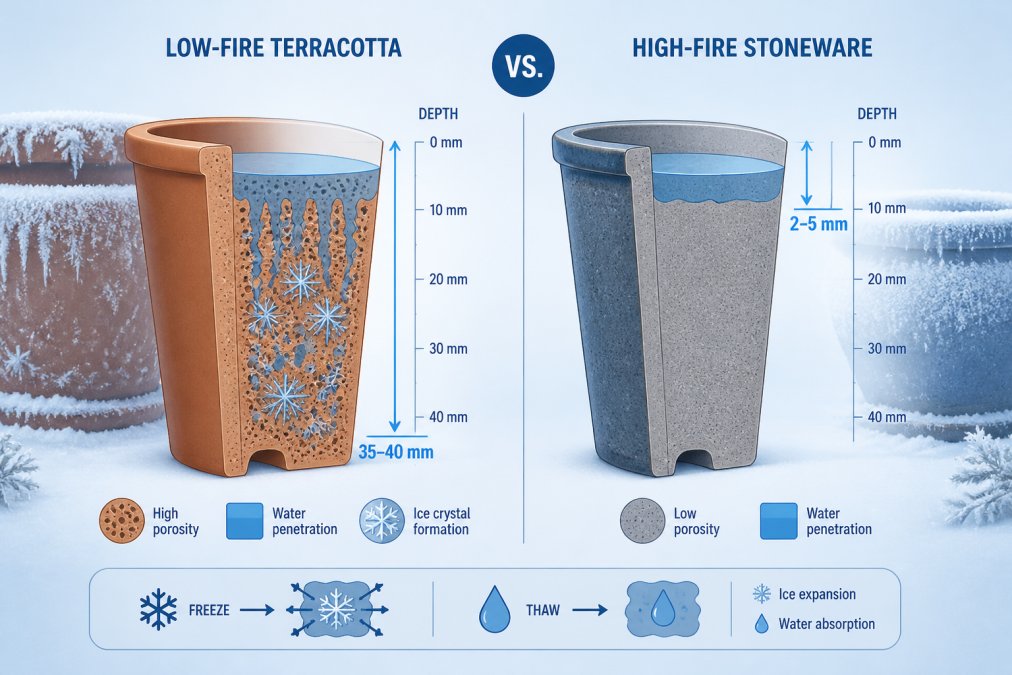
Water expands roughly 9% when it freezes. In a confined space like a ceramic pot, that expansion creates outward pressure. Ceramic has high compressive strength but low tensile strength, it resists being pulled apart poorly. The denser the ceramic body, the better it resists internal stress. Understanding your pot's firing temperature and porosity, plus your local freeze-thaw frequency, lets you choose the right protection strategy.
How to Clean Ceramic Pots Before Storage
Before winter arrives, clean your pots thoroughly to remove debris, soil residue, and pathogens. 🧹
Empty any remaining soil and use a stiff brush to scrub away dried soil, algae, and mineral deposits from interior and exterior, paying special attention to the base and rim. For stubborn deposits, soak the pot in warm water for 30 minutes, then scrub again. Rinse thoroughly until water runs clear.
Next, sanitise using isopropyl alcohol. Mix one part isopropyl alcohol to two parts water and wipe down the entire pot, inside, outside, and base. This kills lingering fungal spores or bacteria. Allow the pot to dry completely for at least 24 hours before storing, wet pots are more prone to frost damage.
Using Pot Feet for Drainage and Ground Protection
Pot feet (also called pot risers) are one of the most effective preventative measures. These small supports elevate your pots off the ground, creating crucial airflow underneath. ✨
When a pot sits directly on soil or concrete, moisture wicks up into the pot's base through capillary action, creating a moisture trap. In winter, that trapped water freezes, expanding and cracking the ceramic. Pot feet solve this by lifting the base 2-5 cm off the ground, allowing air circulation underneath and preventing moisture from being drawn up into the pot.
Choose pot feet made from materials that won't degrade in winter, plastic, metal, or composite options rather than terracotta. You'll typically need three or four feet per pot. Install them before the first frost arrives, spacing them evenly around the base. This is especially important for larger pots, which are heavier and more prone to frost heaving.
Preventing Frost Damage to Garden Pots
Beyond pot feet, several strategies dramatically reduce frost damage risk by minimizing moisture exposure and protecting pots from extreme temperature swings.
Covering and Wrapping Techniques
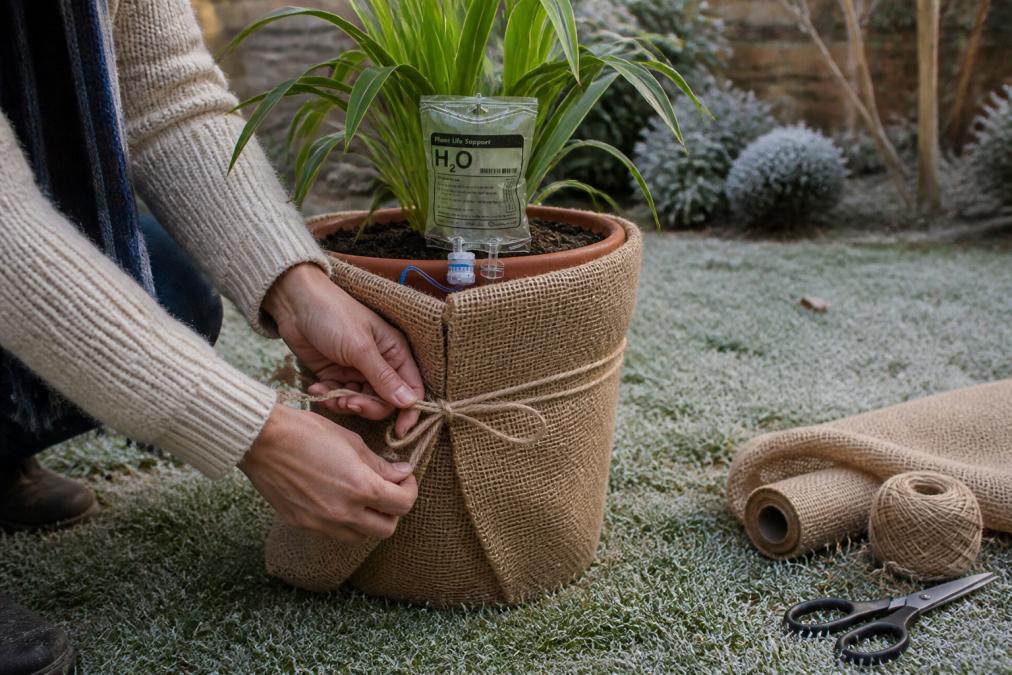
Wrapping your pots provides insulation and shields them from rain and snow. Use breathable materials like burlap or horticultural fleece, which allow moisture to escape while protecting the ceramic from direct weather exposure.
Wrap the pot loosely, leaving a small gap at the base for air circulation. Secure with twine or garden tape. For extra protection, wrap in burlap first, then cover with a waterproof tarp, leaving the base exposed. Avoid plastic sheeting alone, it traps moisture against the ceramic, which is counterproductive.
Choosing the Right Storage Location
If moving pots indoors for winter, select a cool, dry location with stable temperature. An unheated shed, garage, or basement works well. Avoid heated indoor spaces, temperature fluctuation between warm rooms and cold outdoor environments causes thermal shock when moving pots back outside in spring.
If leaving pots outdoors, position them in sheltered areas away from prevailing winds and direct rain and snow exposure. A covered patio, beneath an eave, or against a north-facing wall offers protection. North-facing locations stay cooler and avoid the freeze-thaw cycle triggered by daytime sun warming followed by night-time freezing. Never store pots in low-lying areas where water collects.
Glazed vs. Unglazed Ceramic: Which Survives Winter Better
Material selection determines whether your pots survive winter or crack. Firing temperature and clay density matter as much as the glazed-versus-unglazed distinction. 🏺
Glazed Ceramic: The Winter Advantage
Glazed ceramic is superior for winter survival because the glaze creates a sealed surface that prevents water absorption through pot walls. However, water can still enter through the drainage hole and unglazed base. In winter, moisture accumulates at the base, where it freezes and expands. This is why pot feet and proper drainage remain essential even for glazed pots.
The quality of the glaze matters. A thick, well-bonded glaze on high-fire stoneware performs far better than thin glaze on low-fire terracotta. If the underlying clay is highly porous, water still wicks up through the unglazed base and into the porous clay beneath the glaze, which then traps moisture that freezes and can cause the glaze to crack or peel.
Best practice for glazed pots: Install pot feet to lift the base off ground moisture, position in a sheltered location, and monitor the base for water pooling.
Unglazed Terracotta: High Risk, High Maintenance
Unglazed terracotta is highly porous and absorbs moisture throughout its entire surface, walls, rim, and base. Low-fire terracotta absorbs 8-12% of its weight in water and has lower compressive strength than high-fire stoneware. A single hard freeze-thaw cycle can cause visible cracking; multiple cycles often result in shattering.
Unglazed terracotta requires aggressive protection to survive winter outdoors: wrapping in breathable burlap, pot feet, sheltering from rain and snow, and ideally moving indoors to an unheated shed or garage.
Best practice for unglazed terracotta: Prioritise moving beautiful unglazed pots indoors for winter or wrapping them thoroughly with burlap and securing them in a sheltered location. Combined with pot feet and drainage management, even porous pots can survive, but it requires more effort.
Unglazed Stoneware: The Middle Ground
Some unglazed stoneware is denser and less porous than typical terracotta. High-fire stoneware, even when unglazed, absorbs only 1-3% of its weight in water because clay particles fuse more completely during higher-temperature firing. This creates a tighter clay matrix that resists water penetration and internal stress from freezing.
When buying new pots for winter use, ask the supplier about water absorption rate or firing temperature. Lower porosity (under 5% water absorption) means better winter survival. High-fire stoneware, whether glazed or unglazed, is safer than low-fire terracotta for outdoor winter exposure.
How to Choose Ceramic Pots for Winter Durability
When selecting pots, look for these indicators of winter resilience:
- Glazed surface - Reduces water absorption through walls; check that glaze is thick and evenly applied
- High-fire ceramic - Ask if the pot is stoneware (high-fire) rather than terracotta (low-fire); stoneware is denser and more durable
- Smooth, dense feel - Dense ceramics feel smooth and heavy for their size; porous terracotta feels slightly rough and lighter
- Low water absorption - Look for water absorption below 5%; anything above 8% indicates high porosity
- Thick walls - Thicker ceramic resists cracking better than thin-walled pots
For regions with harsh winters, prioritise glazed, high-fire stoneware. For milder climates with stable cold, glazed terracotta or high-fire unglazed stoneware can work with proper protection. Avoid low-fire unglazed terracotta for outdoor winter use unless you're willing to move pots indoors or wrap them extensively.
Step-by-Step Winter Care for Ceramic Plant Pots
Here's a practical process to follow before winter arrives.
Step 1: Empty Soil and Debris
Remove all soil from each pot using a trowel or small shovel, breaking up compacted soil as you go. Shake the pot gently to dislodge soil clinging to interior walls and base. Use a stiff brush to scrub away remaining soil particles, paying attention to the drainage hole.
Step 2: Inspect for Existing Damage
Examine each pot carefully for cracks, chips, or weak spots, looking closely at the base where most damage begins. Run your fingers along interior and exterior surfaces, feeling for hairline fractures. Minor surface cracks won't necessarily worsen over winter if the pot is properly dried and protected. However, deep cracks or multiple fractures indicate high shattering risk during freeze-thaw cycles.
Step 3: Apply Protective Measures
Clean the pot thoroughly: brush, rinse, sanitise with isopropyl alcohol, and allow to dry completely. Once dry, apply your chosen protection strategy:
- Pot feet: Install risers if the pot will remain outdoors
- Wrapping: Apply burlap and secure with twine
- Waterproofing: Consider a clear acrylic sealant designed for terracotta (optional for glazed pots)
- Sheltering: Position the pot in a protected location away from prevailing rain and wind
Step 4: Position and Store Safely
Place the pot in its winter location, either a sheltered outdoor spot or an indoor storage area. If storing indoors, ensure the location is cool and dry. Stack pots carefully if space is limited, using cardboard or cloth between pots to prevent rubbing. For outdoor pots, ensure they're on level ground with pot feet installed and wrapping is secure.
Monitor your pots periodically throughout winter. If wrapping becomes loose or damaged, repair it. If water pools around a pot, improve drainage or move it to a drier location.
Protecting your ceramic plant pots through winter doesn't require expensive equipment or complicated techniques. The essentials are straightforward: keep moisture out, allow air circulation, and shield pots from extreme temperature swings.
At Quirky Turkey Gifts, we understand that ceramic pots are investments in your garden's beauty. Whether you're choosing glazed ceramic for better winter resilience or selecting unglazed terracotta for its charm, the care principles remain the same. Start your winter prep now, clean, protect, and position your pots correctly, and they'll be ready to brighten your garden again when spring arrives.
For pots that need help staying hydrated year-round, consider pairing your ceramic collection with practical tools like the Plant Life Support automatic waterer (£12.99), which ensures your plants thrive even when you're away. We also offer the Willy the Garden Worm water sensor (£2.75), a charming terracotta tool that changes colour to show when your soil needs water, perfect for monitoring moisture levels before winter storage.


We also have the delightful Hydrating Herbert Self Watering Plant Pot (£14.99) and Hydrating Hettie Self Watering Plant Pot (£14.99) for indoor plants, ensuring your greenery stays happy and hydrated with minimal effort.

Frequently Asked Questions
Can you leave ceramic plant pots outside in winter?
Ceramic plant pots can remain outdoors in winter, but they require protection. Unglazed ceramic absorbs moisture, which expands when frozen, causing cracks. Empty the soil, elevate pots using pot feet to prevent ground contact, wrap them with burlap or horticultural fleece, and store them in a sheltered location like a shed or garage. Glazed ceramic pots are more frost-resistant but still benefit from these precautions in sub-zero temperatures.
How do I stop my ceramic pots from cracking in freezing temperatures?
Prevent frost damage by draining all moisture before winter arrives. Use pot feet to elevate pots and improve drainage, reducing water pooling. Apply a surface sealant to unglazed pots for extra protection. Wrap pots in breathable materials like hessian or horticultural fleece, and store them in an insulated space such as a garage or shed. Avoid rapid temperature changes, as thermal shock accelerates cracking.
Should I empty my ceramic plant pots before winter?
Yes, emptying soil and debris is essential. Moist soil retains water that expands during freezing, putting pressure on pot walls. Remove all soil, rinse the pot thoroughly, and allow it to dry completely. This step significantly reduces the risk of hairline cracks and structural failure. Even decorative pots left outside benefit from being emptied and cleaned before the cold season.
Do glazed ceramic pots handle frost better than unglazed ones?
Glazed ceramic pots are more frost-resistant because the glaze creates a sealed surface that reduces moisture absorption. Unglazed ceramic is porous and absorbs water readily, making it more vulnerable to freeze-thaw cycles. However, glazed pots can still crack in extreme cold or rapid temperature fluctuations. Both types benefit from proper winter storage, elevation with pot feet, and protective wrapping to ensure long-term durability.
This article was written using GrandRanker